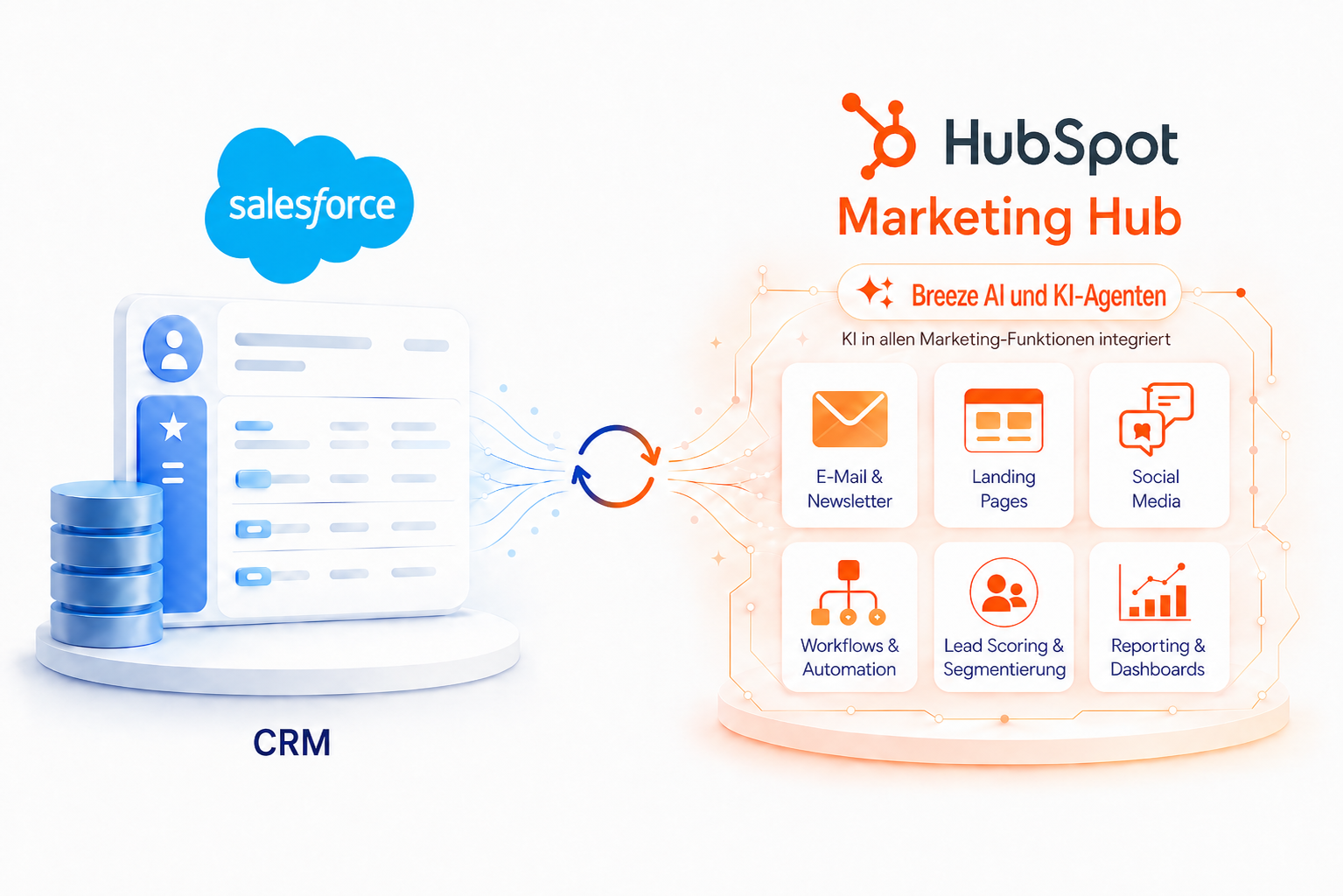
Choosing the right marketing platform is no longer just an IT decision, but a strategic decision. If you want to grow in the coming years, use AI sensibly and remain efficient at the same time, you need a solution that fits the size, pace and reality of Swiss SMEs.
Two solutions are currently the focus of many evaluations:
- HubSpot Marketing Hub - the central marketing solution of the HubSpot platform.
- Salesforce Marketing Cloud Next - the new marketing product from Salesforce announced in June 2025 and gradually rolled out since then.
In this article, we categorize both solutions objectively, compare them according to the criteria that are really crucial for SMEs and give a clear recommendation at the end.

Salesforce Marketing Cloud Next – A Quick Overview
Over the years, Salesforce has built up a network of marketing products through acquisitions: Marketing Cloud Engagement (formerly ExactTarget, B2C), Marketing Cloud Account Engagement (formerly Pardot, B2B), Marketing Cloud Growth, Marketing Cloud Advanced—and now, Marketing Cloud Next.
Marketing Cloud Next is Salesforce’s attempt to simplify this complexity. The platform is natively built on the Salesforce Core platform and Data 360 (formerly Data Cloud). AI capabilities are provided via Agentforce.
Important to note:
-
Marketing Cloud Next is relatively new to the market and is being expanded incrementally through quarterly releases. Key features such as Business Units or dedicated IPs only became generally available in the Spring '26 release.
-
Many core features are not included in the license but require additional products—such as Data 360 for data harmonization, Agentforce for AI capabilities, or Marketing Cloud Intelligence for reporting.
-
Licensing follows a credit model: mailings, AI actions, and data processing consume credits, which makes it difficult to plan campaign costs.
HubSpot Marketing Hub – A Quick Overview
HubSpot Marketing Hub ist die Marketing-Lösung innerhalb der HubSpot Plattform. Marketing, Sales, Service, Content und CRM teilen dasselbe Datenmodell und dieselbe Oberfläche.
Wichtig dabei:
- Smart CRM ist in jeder Lizenz enthalten – ohne Aufpreis.
- Funktionen wie E-Mail, Social Media, Werbeanzeigen, Landing Pages, Automation, Reporting, KI-Assistent und KI-Agenten sind Teil der Plattform.
- Daten und Aktivitäten aus Marketing, Sales und Service liegen in einem einzigen Datensatz pro Kontakt – ohne Brüche zwischen Systemen.
Kurz gesagt: Marketing Cloud Next ist ein Neuanfang innerhalb eines historisch gewachsenen Salesforce-Ökosystems. HubSpot Marketing Hub ist eine in sich geschlossene Plattform, die von Beginn an auf eine integrierte Customer Journey ausgelegt wurde.
The comparison: four criteria that really count for SMEs
From our projects with Swiss SMEs, we know that the choice of platform in marketing is not primarily about feature lists. Four dimensions are decisive.
1. Intuitive operation - the the marketing team must be able to work with it
A marketing platform does not develop its benefits through its range of functions, but through adoption. What is not used does not generate ROI.
Independent sources show a clear picture here:
- On G2, HubSpot Marketing Hub scores 8.6 for Ease of Use, Salesforce Marketing Cloud 7.6. For Ease of Setup it's 8.1 versus 7.3, for Ease of Admin 8.5 versus 7.8.
- Verified HubSpot users repeatedly describe the interface as "intuitive and powerful at the same time" - you don't have to be a marketing operations specialist to set up workflows or campaigns.they are embedded in business processes
- Salesforce marketing consultants themselves openly say that Marketing Cloud Next is intended as a "massive reset" to the complexity that has grown historically - an admission that the previous Salesforce marketing solutions were too complex for many teams.
2. All in one solution - instead of multiple clouds
Salesforce markets Marketing Cloud Next as a unified platform. In practice, however, many relevant functions are only covered by additional products or modules:
*AEO = Answer Engine Optimization, i.e. visibility in AI-based search systems such as ChatGPT or Perplexity.
It is important to note that every line with "only with ..." actually means an additional product, an additional license, an additional implementation and an additional supplier in the stack.
This is exactly what describes the "demo vs. reality" phenomenon within the industry: a comprehensive solution is shown in the sales demo, but in the contract and in everyday life there are missing components that have to be purchased later.
For SMEs, this means that what was purchased as one solution becomes a construct of several licenses with their own data models, interfaces and update cycles during operation.
3. Targeting and segmentation - simple
simple, data-based and without data chaos
Targeting is only as good as the data behind it. And data can only be used if all relevant touchpoints - CRM, website, email, service, sales - converge in one data model.
In HubSpot, this data model is standardized right from the start:
- Contacts, companies, deals, tickets and custom objects are in the same CRM.
- Behavioral data from the website, forms, emails, calls and chat flow automatically into the contact data record.
- Lists, workflows and reports access this data directly - without separate data extraction or an additional data platform.
The situation is different in Salesforce. Marketing Cloud Next is based on Data 360 , an independent data platform that merges and harmonizes data from various Salesforce clouds and third-party systems. Salesforce itself describes Data 360 as a kind of "keychain" between the systems - an image that makes it clear that the data is not originally located in one system.
4. Media disruption-free AI - the real strategic lever
This is the most important difference - and also the point that will determine competitiveness in the next two to three years.
AI is only effective if it:
- can access complete, up-to-date customer data
- is embedded in the daily workflow
- does not have to be orchestrated across multiple tools, logins and data models
In HubSpot, AI - under the brand name Breeze - is not an additional product, but part of the platform. The AI assistant is available in the CRM, in the email editor, in campaign planning, in reporting and in customer service. AI agents work with the same data as marketing, sales and service employees.
If you would like to take a closer look at data protection, security and the underlying LLMs, you can find more details in our article on AI agents in HubSpot.
In Salesforce Marketing Cloud Next, AI is provided via Agentforce. In concrete terms, this means
- Agentforce is a separate product with its own licensing - the AI functionality is not part of the Marketing Cloud license.
- In order for Agentforce to work productively, data from Data 360 is required - another module that requires a license.
- Functions such as an AI customer agent or user-defined AI assistants usually require Agentforce + Agentforce Service in addition to Marketing Cloud Next.
In-depth practice: Newsletter, tracking and AI personalization
Newsletters are one of the most important digital marketing channels for most SMEs. This is precisely where it becomes particularly clear how differently the two platforms are structured.
Who opens, who clicks - and what happens afterwards?
Knowing open and click rates is the minimum standard today. The follow-up questions are crucial for marketing managers:
- Which recipient has clicked - and what stage are they currently in?
- Which link in the newsletter was clicked?
- Where did the click lead to - and what happened afterwards (page view, form, call, deal)?
In HubSpot Marketing Hub, all this data is stored in one data record per contact:
-
- Each click per recipient appears directly in the contact profile in the CRM.
- An integrated click map visually shows which areas in the newsletter are performing how.
- After the click, HubSpot automatically links the behavior with page views, form entries, calls, meetings and deal activities - in a continuous timeline.
- Customer journey analytics and multi-touch revenue attribution are included in the platform and show which newsletter contributed to which revenue.
In Salesforce Marketing Cloud Next:
- Engagement data is located in so-called Data Model Objects within Data 360 and must be merged for reports.
- Web traffic analytics - i.e. the bridge from newsletter clicks to downstream website behavior - are not included in Marketing Cloud Next.
- Customer journey analytics and multi-touch revenue attribution are also not included; the latter also requires Marketing Cloud Account Engagement.
- More detailed evaluations only came with the Spring '26 release, for example via the new conversion and engagement history dashboards based on Tableau Next.
Personalization and context: what AI can really do in newsletters
Personalization has long meant more than just the first name in the salutation. Modern newsletter marketing is about:
- Content that matches the purchase phase and the recipient's behavior
- Sending times that are individually optimized for each recipient
- Content variants that are tested by AI and played out automatically
- Language versions that are created without a separate translation agency
- AI assistants that suggest subject, text and segment directly in the editor
In HubSpot all of this is part of the platform:
- AI Content Generation, AI Content Variants, AI Content Remix and AI Content Translation are included in Marketing Hub.
- Send Time Optimization determines the best send time for each recipient.
- Smart Content dynamically exchanges texts, images or CTAs - according to lifecycle stage, language, industry, behavior or any CRM properties.
- As an AI assistant,Breeze provides support directly in the editor: during writing, variant testing and segment selection - without having to switch tools.
In Salesforce Marketing Cloud Next:
- AI Content Generation and Send Time Optimization are included.
- Email A/B Testing, AI Content Remix and AI Content Translation are not included in Marketing Cloud Next.
- Custom AI Assistants - i.e. newsletter-specific AI agents - require Agentforce as an additional product.
- Two-way conversationsvia email (Two-Way Conversational Email, new in Spring '26) are an interesting approach, but also require Agentforce.
What do users themselves say?
We analyzed evaluation platforms such as G2, Capterra, Gartner Peer Insights and industry analyses:
- HubSpot Marketing Hub is mentioned particularly frequently: standardized platform, intuitive operation, powerful automation, clear lead and sales handover. Point of criticism: Prices rise noticeably with increasing contacts and functions.
- Salesforce consultants themselves paint a sober pictureof Salesforce Marketing Cloud Next: the product is a necessary reset, but many functions will only come with the next releases. Those who migrate today consciously accept that they are working with a platform that is still under development.
Market statistics also show that HubSpot has more customers globally than Salesforce CRM (288,000+ vs. 150,000+) and leads in the corresponding G2 categories for marketing and sales products.
Total cost of ownership - the underestimated factor
SMEs often look at the annual license price. But the honest question is: What does the platform really cost over three years?
The Total Cost of Ownership (TCO) includes:
- License and subscription costs
- Add-ons (e.g. Data 360, Agentforce, Marketing Cloud Intelligence)
- Implementation and onboarding
- Data migration and integrations
- Ongoing administration and specialist expertise
- Training and adoption costs
Salesforce licenses often appear cheaper in the first year - the reality is often different in years two and three. The industry consensus: With classic Salesforce stacks, the pure license often only accounts for 30-40% of the total costs. The rest is made up of add-ons, implementation, consulting and maintenance costs.
HubSpot is generally more transparent and easier to plan thanks to its uniform license model (functions instead of add-ons) and the reduced need for external specialists. Migration examples such as Lendlease show that the total cost of ownership could be reduced by up to 78% when switching from Salesforce to HubSpot - with a comparable range of functions.

Our recommendation for Swiss SMEs
For most medium-sized companies in Switzerland - typically with a lean marketing team, tight IT resources and a legitimate need for fast results - HubSpot Marketing Hub is the much better choice. For these reasons:
Salesforce Marketing Cloud Next can be a sensible choice for very large corporations that are already deeply rooted in the Salesforce ecosystem, employ their own Salesforce development teams and want to orchestrate their marketing strategy around Data 360 and Agentforce over several years. For traditional Swiss SMEs, this setup is oversized in the vast majority of cases and difficult to justify economically.
Conclusion
The most important question when choosing a marketing platform is not "Which system offers the most functions?", but "Which system will enable our team to actually create value in the next three years - consistently, based on data and supported by AI?"
For Swiss SMEs, there is a lot to be said for an integrated, intuitive and AI-native platform.HubSpot Marketing Hub fulfills exactly this requirement - with a short time-to-value, transparent costs and an AI that works without media disruptions.