In our consulting projects, we hear the question more and more frequently: "Can we introduce HubSpot Marketing Hub without having to give up the Salesforce CRM?" The short answer: yes. The slightly longer answer: surprisingly uncomplicated if you take a structured approach.
Why this combination works
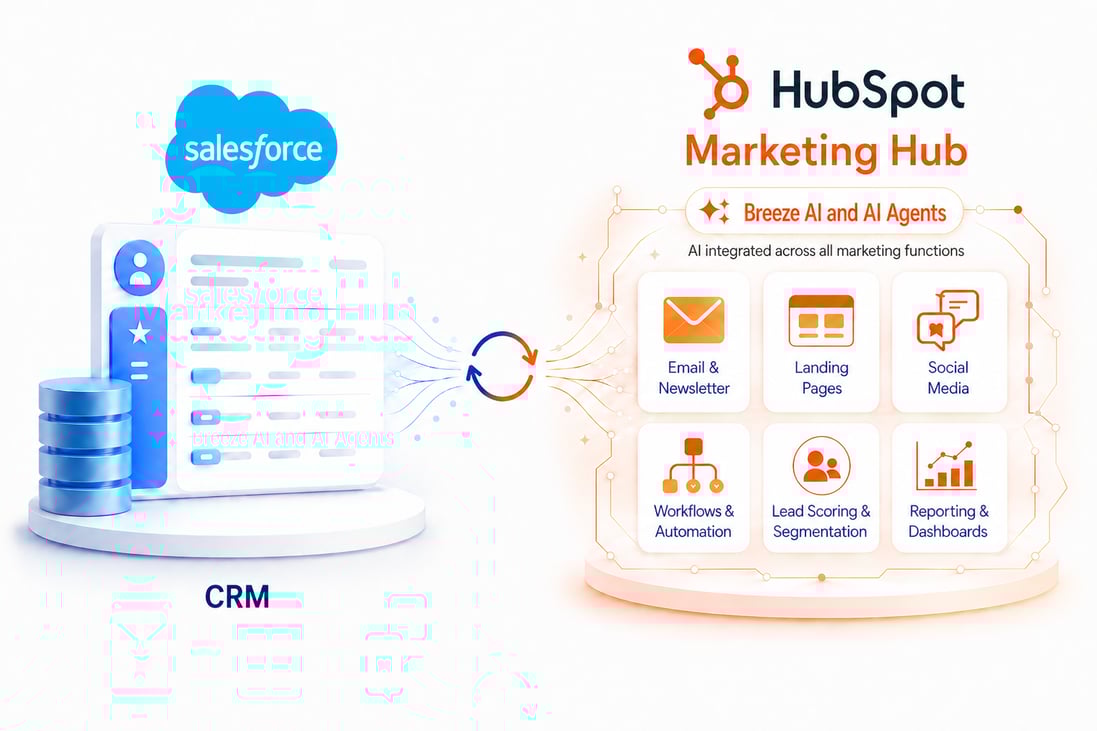
HubSpot Marketing Hub and Salesforce CRM are one of the most widely used hybrid setups in B2B marketing today. Over 10,000 companies worldwide use the HubSpot-Salesforce integration productively. It is deep, bidirectional, developed by HubSpot itself and maintained by a dedicated team.
The HubSpot Salesforce integration is one of the highest rated apps on the Salesforce AppExchange with 4.61 out of 5 stars and almost 600 verified reviews. Joe Hall, Lead Consultant at OBO (now Aptitude 8), sums up the experience of many users: "HubSpot integrates better with Salesforce than some of Salesforce's own marketing systems."
It is important to note that in this setup, Salesforce is the system of record for sales data and HubSpot is the system of record for marketing data. Both systems exchange exactly the data that the other needs. No more, no less.
What about Marketing Cloud Next?
In almost every initial conversation, the question comes up: "But Salesforce has now announced Marketing Cloud Next. Wouldn't that be the more natural way to go?" Our clear assessment: HubSpot Marketing Hub is the more practical choice for SMEs today. Marketing Cloud Next is an ambitious platform that is still under construction. Even classic marketing functions such as email A/B testing or the AI-supported translation of multilingual campaigns are not available today, or only to a limited extent. AI personalization, data harmonization and multi-touch attribution require additional, paid products such as Agentforce or Data 360.
HubSpot Marketing Hub is now fully operational, available in a single license and has a clear advantage in the key dimensions: intuitive operation, seamless AI and predictable total costs. We have documented a detailed comparison of the two solutions in a separate article.
The five phases of a clean switch
Five clearly defined phases have emerged from our projects.
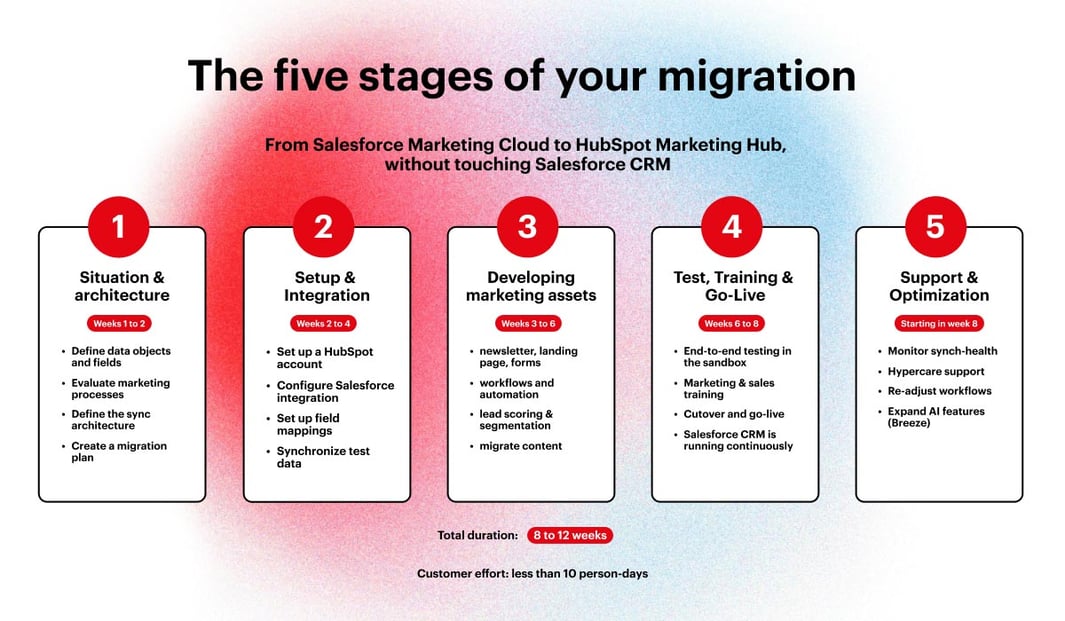
Phase 1: Initial situation & architecture (week 1 to 2)
We analyze together with you:
- Which data objects (contacts, companies, leads, opportunities) are in play?
- Which fields should be synchronized, and in which direction?
- Which marketing processes from Salesforce Marketing Cloud are business-critical today?
- Which of these will be replicated 1:1 and which will be improved?
Phase 2: Setup, data model & integration (weeks 2 to 4)
- HubSpot account is set up: lifecycle stages, properties, lists, users, authorizations.
- The HubSpot-Salesforce integration is installed and configured: Field mappings, sync rules, inclusion lists.
- The first test data records are synchronized and checked manually.
Phase 3: Setting up the marketing assets (weeks 3 to 6)
- Newsletter templates, landing pages, forms and workflows are rebuilt in HubSpot, in the brand design and with the platform's best practices.
- Existing content from Salesforce Marketing Cloud (templates, lists, subscriber data) is migrated or deliberately redesigned.
- Automations, lead scoring and segmentation logics are set up.
Phase 4: Test, training and go-live (weeks 6 to 8)
- End-to-end tests in the HubSpot sandbox: from form submission to lead routing in Salesforce and email automation.
- Training for marketing and sales teams in live sessions, supplemented by HubSpot Academy.
- Go-live with clearly defined cutover. Salesforce CRM continues to run without interruption.
Phase 5: Support and optimization (from week 8)
- Monitoring of Sync Health between HubSpot and Salesforce.
- Hypercare phase with direct support for the marketing team.
- Fine-tuning of workflows, reports and AI functions (Breeze).
What we specifically do as an agency
We support you not only professionally, but also operationally. Specifically, we take on
- the complete technical configuration of HubSpot and the Salesforce integration
- Data migration from Marketing Cloud (contacts, lists, subscribers, templates, reports)
- the creation of newsletter, landing page and form templates in the corporate design
- the translation of your existing customer journeys into HubSpot workflows
- Lead scoring, lifecycle logic and routing between HubSpot and Salesforce
- Setup of reports and dashboards, including cross-platform reporting
- Training for your teams in marketing, sales and IT
- Hypercare and ongoing optimization after go-live
What you actually need to invest as a customer
Experience shows that this is the point that concerns management the most. In reality, the cost is much lower than expected. For a typical SME project, we expect the following expenditure on your part:
How long does the whole process take?
For a typical medium-sized company, we estimate 8 to 12 weeks from kick-off to productive go-live. HubSpot itself states three months as the average migration period. This figure is also confirmed by independent HubSpot Diamond partners. For a pure marketing migration with retained CRM (i.e. exactly your case), we are at the lower end of this corridor.
By comparison, a Marketing Cloud Next implementation typically involves a significantly larger project scope for medium-sized companies. It requires additional Salesforce components, above all Data 360 for data harmonization and Agentforce for AI functions. This extends the duration of the project and requires specialized Salesforce expertise, which is rarely available internally in SMEs.
Why the whole thing is less complex than it sounds
Many marketing managers fear migrations because they think of large, comprehensive CRM projects. However, a Marketing Cloud to HubSpot migration with retained Salesforce CRM is fundamentally different:
- The CRM remains untouched. Sales processes, pipelines, forecasts, reporting: everything simply continues to run in Salesforce.
- The integration is a standard product. It is not developed, but installed and configured. The complexity lies in the clean data modeling, not in the code.
- Both systems can run in parallel. We migrate in clearly defined steps, not in one big bang. Marketing Cloud remains active until the go-live. The typical worry of "What if something goes wrong?" doesn't even arise.
- HubSpot is intuitive to use on a day-to-day basis. Marketing teams are usually productive within a few weeks without having to hire additional specialists.
Here's a quote from a verified G2 user: "It's intuitive and powerful at the same time. You don't need to be a marketing operations specialist to set up workflows or campaigns."
Conclusion
Switching from Salesforce Marketing Cloud to HubSpot Marketing Hub while retaining Salesforce CRM is now a clearly structured, easy-to-plan standard process. Not a risk. In around three months, with manageable effort and no risk for your sales organization, you gain a modern, AI-native marketing platform while retaining the investment in your CRM.