Skip to content

Digitizing marketing, sales and service: how to get to a target picture, roadmap and budget

Starting the digitalization of marketing, sales and service is easier than many executive teams think. With the right approach, a complete decision basis emerges within a few weeks: a clear current-state picture, a shared target picture, a future system architecture, and a roadmap with budget. This article shows the path there, step by step.

Digitizing marketing, sales and service: how to get to a target picture, roadmap and budget
15:39

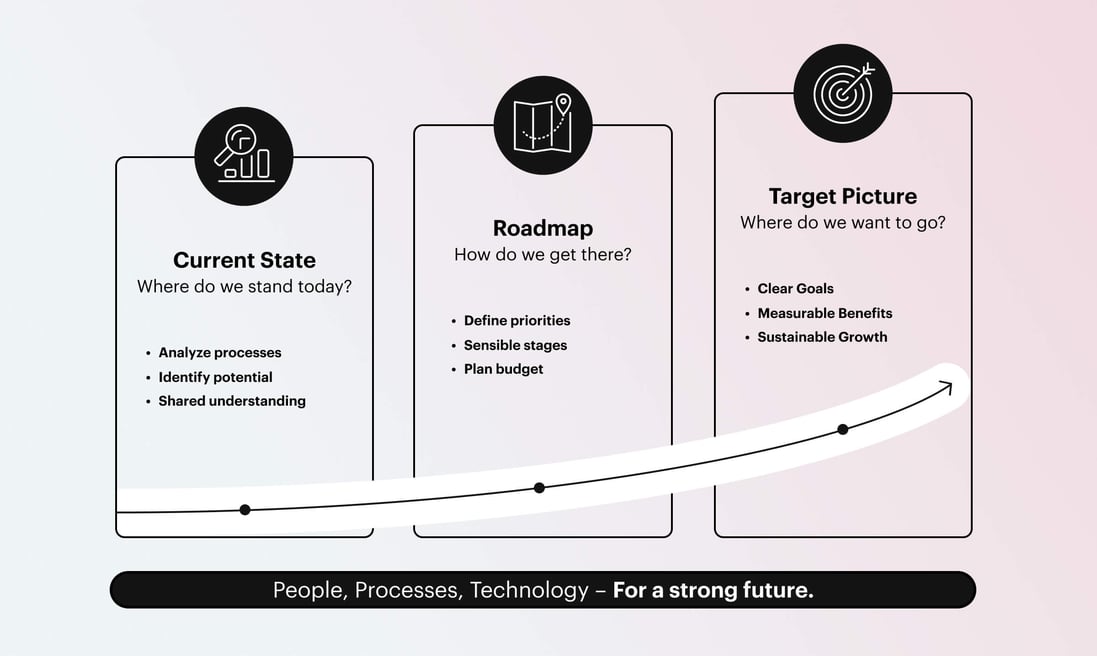
b4you-alignement-digitalaisierungsprojekte-1200x700-en

I am writing this article from my own experience as CEO and from dozens of projects with companies in the Swiss mid-market. The questions that come up in the boardroom at the start are never “Which CRM should we buy?” They are different. How do we start, and where? What do we do so we don’t get lost and the whole thing doesn’t become too complex? And how do we break such an initiative into sensible steps? The good news up front: there is a proven, pragmatic path that takes a few weeks and costs your leaders only individual half-days.

At the end you hold three things in your hands: a target picture (where I want to go), a digitalization roadmap (the path to the goal), and a high-level budget (what it will cost me).

What do successful companies do differently?

They connect technology from the outset with their processes and goals. McKinsey’s “The State of AI” study (2025) makes this clear. Almost all companies now use AI, but the group that achieves a measurable profit contribution stands out for one factor in particular. These companies have fundamentally redesigned their ways of working, rather than putting new tools on old processes. This is exactly where the opportunity for the mid-market lies. Those who first clarify the customer process and then digitize it belong to the successful group from the start.

Schweiz

For Switzerland, the digitalization study by the School of Business FHNW, with more than 2,500 companies surveyed, confirms the link. Those who proceed in a structured way with a clear direction are significantly more satisfied with the results of their own digitalization. What matters is what structure means — and what it does not. You do not need an enterprise-wide digital strategy that takes months to develop and ties up leadership capacity. You need your existing corporate strategy as a compass, and from it a focused target picture for the concrete digitalization initiative — here, the customer process.


Which questions get you to the goal?

A proven question catalogue along five dimensions — business, processes, systems, data and organization — ensures that everything essential is addressed. The scope of consideration is just as important. This is about your customer process, end to end from lead to loyalty: from first contact through marketing and sales to service, customer development with cross- and up-selling, and long-term retention. Only this process is examined. That boundary is important in order to keep a clear focus.

These questions belong on the table:

  • Which business goals have priority over the next two to three years, and what must be achieved in the customer process for digitalization to count as a success?

  • Do the relevant stakeholders share a common understanding of today’s starting point, the target picture and the biggest gaps?

  • How does the customer process from lead to loyalty run end to end today, where do the biggest friction points arise between marketing, sales and service, and who carries which roles and responsibilities per team?

  • Which metrics would be relevant for steering the customer process but are not reliably available today?

  • Which fields of action have priority, and which business cases with the greatest benefit for the business follow from them, bundled into implementable work packages?

  • Where do customer, lead and order data sit today, which system owns which data, and what is the state of their quality, recency and completeness?

  • What does the future system architecture look like at a high level? Which role do existing systems keep, where could a customer platform or CRM take on the function of a single source of truth for all lead and customer data, and where would interfaces be needed?

  • How ready is the organization for change, and how will employees be guided through it with communication, training and support?

  • What could the digitalization roadmap look like? Which MVP do we start with to create visible value quickly, in which stages do we proceed, and what belongs in which stage?

  • What does the initiative cost at a high level in one-off implementation, ongoing licences and internal effort?
You do not have to answer these questions alone, and certainly not all at once. That is exactly what the alignment is for. We work through the catalogue with you systematically and in a structured way, step by step and in the right sequence. You bring your business knowledge; we bring the method, the facilitation and the experience from comparable projects.

How does the current state become clear?

A clear current-state picture consists of three things: a picture of your customer process as it actually runs today, an overview of which systems are in use and where which customer data sit, and an honest list of friction points and gaps. That is lean and focused, and it is doable.

The reassuring part is that all the knowledge for this already exists in your company. Your sales lead knows which customers used to order regularly and no longer do. Your inside sales team knows which details they have to gather by hand from several systems for every quote. Your IT knows which systems are connected to what. So you need neither a weeks-long survey nor prepared documents on your side — you need the right method to make that knowledge visible together with us.

The core of this method is a well-prepared workshop with representatives of the executive team and dedicated subject-matter experts from marketing, sales and service. There we walk through the customer process from lead to loyalty with you. 

At every station we ask the same four questions.
  • What actually happens here today?

  • Who does it?

  • With which system?

  • And which data are created, and where are they maintained? 

The exercise sounds simple, and that is exactly its power. Not infrequently it shows that leadership, sales and service had three different pictures of the same process in their heads until then. At the end of the workshop, for the first time, the one shared picture is on the wall, and the biggest opportunities are visible to everyone.

→ Whatever is still open afterwards is deepened in a targeted way, in two to three short conversations with individual key people — for example with the CIO on systems and interfaces, or with the CFO on metrics. We, as digitalization experts, take on the condensation into a documented current-state picture for you.

How does a clear target picture emerge?

The target picture describes how your customer process will work in future — digitized, reasonably automated and with integrated AI. It emerges from the comparison with the current state. This is where we stand; that is where we want to go.

firma

An example makes it tangible. Take a trading company with 8,000 customers, 2,000 of whom have not ordered in more than a year. The target picture then states, for instance, that inactive customers will in future be recognized automatically and reactivated with matching offers, measured by revenue from reactivated customers after twelve months. A vague intention (“we want to become more digital”) becomes a concrete, measurable initiative.

A target picture is clear when it is prioritized and owned. Prioritized means few fields of action with a clear ranking by business benefit. Owned means the entire executive team and the key users in your company stand behind it, because they developed it together.

How do the needs of the business units feed in?

In a structured way, in the workshops and short alignments per area, and always along the customer process. The key users — the people who work with the processes every day — bring in their concrete issues, such as double data entry, missing information in customer conversations, or manual workarounds. From that, business cases are derived, prioritized by benefit and bundled into work packages. The executive team decides the ranking.

→ This approach delivers two things at once. The requirements are real, because they come from the people who live the process. And acceptance of the later solution already starts here, months before go-live, because the teams find their own topics in the roadmap.

What does the target system architecture look like?

For most mid-sized companies the answer is a clearly ordered interplay of two cores. The ERP remains given and, as the financial-operational truth, owns orders, articles and finance. Alongside it sits a customer platform or CRM with marketing, sales and service functions. The webshop and other tools connect via defined interfaces. Why these two core systems form the foundation of every company, and how third-party systems are added cleanly, we have set out in the article Best of Breed is not a choice, it is reality.

The target architecture emerges as a high-level target picture based on the existing system landscape, and its central element is clarified data ownership. For every data domain — from the customer master through orders to marketing and service data — it is defined which of the two core systems owns the data and which systems only use them. That way the data stay consistent everywhere: the foundation for reliable reporting and for every use of AI. In this architecture, AI is not a system of its own, but a capability that sits on clean, connected customer data and makes sales and marketing measurably more effective. Why the sequence is use case, data architecture, then AI, we have explained in the article First the use case, then data architecture, then AI. Also worth reading in more depth: AI has made its way into sales sales – but without clean data, it’s a waste of time

In which steps does the alignment run?

The alignment follows five steps and takes four to ten weeks, depending on how deep you go:

Pre-alignment.

Define the decision question, expectations and working frame with the executive team. What should be decidable at the end, and who is involved?

Preparation and workshops.

Run the sessions with representatives of the executive team and dedicated subject-matter experts from marketing, sales and service — on the target picture as well as on processes and requirements.

Analysis and preparation.

Condense the results into a target picture with prioritized fields of action and concrete starting options.

Roadmap and high-level budget.

Plan the initiatives in stages, with a high-level budget that sets implementation costs, ongoing licences and internal effort against expected benefit.

Results presentation and decision.

Present the target picture, digitalization roadmap and high-level budget in a simple, well-structured way, and introduce the starting options. Your company itself then sets the starting point that fits.


Condensed, you receive a target picture (where I want to go), a digitalization roadmap (the path to the goal) and a high-level budget (what it will cost me). The roadmap deliberately starts with an MVP — a first initiative with quickly visible value. After that you decide on the investment, with a complete basis.

How do you know you are ready to start?

By four statements your entire executive team can sign. We have a shared, documented picture of our current state. We have a prioritized target picture with metrics that everyone stands behind. We know which system will take on which role in future, and which requirements from the business units will be implemented in which order. And we know the investment and the expected benefit over the coming years. Anyone familiar with the term will recognize a Target Operating Model (TOM) for the customer process — here in a lean form that fits the mid-market. How this thinking model gives a CRM implementation the larger frame is shown in our article Target Operating Model: How your CRM implementation moves the whole company forward [INSERT LINK ONCE PUBLISHED]. With these four answers you take your investment decision in a focused, professional and confident way.

Your start in four to ten weeks with Alignment from business4you

This is exactly the path we take with you in Alignment, our offering for the start of digitalizing marketing, sales and service. Together with your executive team and your subject-matter experts, we develop the current state, the target picture, the target system architecture and the prioritized requirements, condensed into a digitalization roadmap with high-level budget as the decision basis.


Is a CRM evaluation on your agenda, is a digitalization investment waiting for approval, or do you want to use AI in the customer process and are looking for the right entry point?

Then book a no-obligation first conversation. We listen, look at your starting point with you, and show you how you get to a target picture, roadmap and budget in a few weeks.
Talk to us about your starting point or call us directly: +41 32 376 00 76.

Frequently asked questions from executive teams before the start

What is Alignment from business4you?

Alignment is business4you’s starting offer for the digitalization of marketing, sales and service. In one to two workshops with the executive team and subject-matter experts, a complete decision basis emerges in four to ten weeks: target picture, digitalization roadmap and high-level budget.

Do we need our own digitalization know-how in-house to start?

No. For the clarification phase at the beginning you need business knowledge, and your people have that. We bring the digitalization and method know-how and apply it where it is useful to you.

How do we build our own know-how to run the customer platform?

Through defined roles that are built up in the project — for example key users in the business units, admin users for system maintenance, and data owners for data quality. That way know-how grows step by step in your house.

How quickly does the digitalization of marketing, sales and service show first results?

The decision basis is available after four to ten weeks. First operational results come from the first initiative (MVP), typically a few months after approval, because we deliberately start with the initiative that delivers the greatest benefit.

What does digitalizing marketing, sales and service cost?

The investment consists of three blocks: one-off implementation costs, ongoing licences and internal effort. How high it is depends on the scope of the first stages. The high-level budget, set against expected benefit, is on the table before the investment decision. Entering via the clarification phase costs only a fraction of the later investment.

What if we have already evaluated CRM systems?

Even better. The clarification phase delivers the criteria against which you measure the candidates: target picture, prioritized business cases and system roles. Often it confirms a shortlist and gives you the confidence for the decision.

{}