-
AI is now part of everyday sales operations – no longer a pilot project. 92% of sales professionals already use AI tools.
-
A CRM module within an ERP is not a sales CRM. Anyone who manages “Sales” through the customer module in their ERP is giving away the leverage that an intelligent CRM provides today.
-
Data is the new prerequisite for AI to unlock its full potential in Sales. If data is not centralized, companies automate gaps instead of creating value.
-
Disconnected systems are the biggest hidden efficiency killer in Sales – and the point where AI currently loses the most impact.
-
Sales digitalization is a small internal revolution – but it leads to a harmonized process, real-time analysis, and AI that finally delivers. Exactly what management teams have been trying to achieve with BI tools for years, but never truly managed to accomplish.

If management teams were still debating over the past two years whether AI would become relevant in Sales, today they are discussing how quickly their organization can catch up. The numbers leave little room for interpretation:
At the same time, one in three Sales teams says that the use of AI and automation is currently the biggest challenge in the sales process (HubSpot Sales Trends Report). That is the honest reality: The technology is here, but the knowledge required to use it productively is still lagging behind.
What we specifically observe in our projects: Expectations for an initial sales conversation have changed. A managing director who has already read white papers, visited the pricing page, and filled out a form expects the salesperson to know this and build on it. Not “May I briefly introduce our company?”, but rather “You seem to be dealing with challenge X – I would like to pick up from there.” If the customer has to repeat themselves, they feel that the company was not listening.
This is not a soft assumption. Forrester states that 82% of global B2B decision-makers expect buyers to receive tailored experiences in Marketing and Sales (The State of B2B Personalization, Forrester Research, 2024). Gartner adds that 86% of B2B customers expect companies to know their personal information before the conversation begins.
That is exactly what data and AI provide. A CRM that captures all of a lead’s digital touchpoints gives the salesperson complete context before picking up the phone. AI prepares the conversation – the customer does not have to repeat themselves, and the salesperson does not ask what they already know. That is the difference between a salesperson with data and one without.

The uncomfortable truth: AI is only as good as your data
AI is not a magic button. It is a pattern-recognition and writing tool that works with the data it finds. The consequence for owner-managed mid-sized companies is uncomfortable but clear:
Anyone who does not have their sales data centralized, complete, and compliant with data protection requirements in one place is automating gaps instead of creating value.
Data has always been important. But today, it is a prerequisite, not a nice-to-have. This is exactly where the strategic opportunity lies: Companies that now consolidate their own Sales data cleanly in their CRM create the foundation on which AI can actually increase efficiency – and do so exclusively for them. This data foundation cannot simply be bought. It is your real competitive advantage.
In almost every management discussion we have on the topic of CRM, this argument comes up sooner or later: “But our ERP already has a customer or CRM module. Isn’t that enough?” Understandable – the ERP is usually the most expensive system in the company, and nobody likes investing twice. Nevertheless, in the vast majority of cases, the answer is: No, it is not enough. And not because the ERP is bad, but because it has a different purpose.
An ERP is designed around master data and transactions: customer number, billing address, terms and conditions, order history, receivables. These are business-critical data – but they are the result of Sales, not its tool. A modern sales CRM such as HubSpot is focused on what comes before: Who is actually a lead? When are they ready to buy? What convinced them? Which touchpoints had an impact?
When we start new projects at business4you, one of our first questions is: “How is your CRM actually being used today?” The answer is surprisingly often the same – even in companies that have been working with a modern system such as HubSpot for years. In the 24 CRM projects we have supported over the past two years, this pattern was the norm: The CRM was used almost exclusively by Marketing. Newsletters, forms, lead capture, campaign reporting. It works, but it is only half the potential.
The major leverage comes from ensuring that Sales also consistently builds on this data foundation and runs everything through the CRM:
- all emails to leads and customers
- all meeting notes (ideally automatically transcribed)
- all notes, calls, quotes, contracts
- all activities and status changes
As long as customer information is stored in a field salesperson’s personal Outlook, in WhatsApp conversations on private phones, or in local Excel spreadsheets, it does not exist for the company – and it is invisible to AI.
And it is not just about AI. It is about a risk that every owner-managed mid-sized company knows: When a salesperson leaves the company after four years, the knowledge leaves with them. The relationships they have built, the context surrounding important customers, the anecdotes and nuances that can determine a meeting – all of this is currently stored in people’s heads, personal mailboxes, and notebooks. A consistently maintained CRM is the only structural answer to this. People may leave – but what the company knows about its customers remains.
When we conduct a Sales audit as part of a project and spend a day with field sales representatives, we almost always see the same morning routine. A good B2B salesperson typically prepares for an initial conversation with a lead as follows:
Five to six tools. Multiple copy-and-paste steps. Data that looks slightly different in every system. These are disconnected systems – and they cost companies in three ways at the same time:
-
Time: According to HubSpot research, sales professionals spend only around one-third of their working day actively selling – the rest goes toward research, administration, and CRM maintenance. Exactly where Sales creates the most value – in conversations with leads and customers – there is not enough time.
-
A rule-of-thumb calculation for mid-sized companies: 10 sales professionals × 2 hours of research/administration per day × CHF 100 fully loaded cost per hour × 220 working days = around CHF 440,000 per year currently spent on activities that an integrated CRM with AI can largely take over. With 30 sales professionals, the figure is more than CHF 1.3 million.
-
Data quality: What happens in the AI assistant, what was read on LinkedIn, and what was written in Outlook – none of this automatically ends up in the CRM. The most important information therefore remains outside the system that is supposed to consolidate it. The AI within the CRM remains blind because it never sees this layer of context.
-
Data protection and compliance: When customer data is copied into an external AI chat, users often do not know where that data ends up. Under Switzerland’s revised Federal Act on Data Protection (nFADP) and the GDPR, this is an increasing problem in regulated industries – and a liability risk for management that is rarely on the radar.

The decisive difference with an intelligent CRM that has AI built in: The AI sits where the data already exists. In a HubSpot setup, this specifically means:
Sales is currently the least digitalized and least transparent area in many mid-sized companies. This is no coincidence: Salespeople have traditionally been able to design their processes largely themselves. That was both a strength and a blind spot.
In the more than 12 companies we have supported over the past two years in the AI-supported digitalization of their Sales operations, we see almost the same progression every time – in this order:
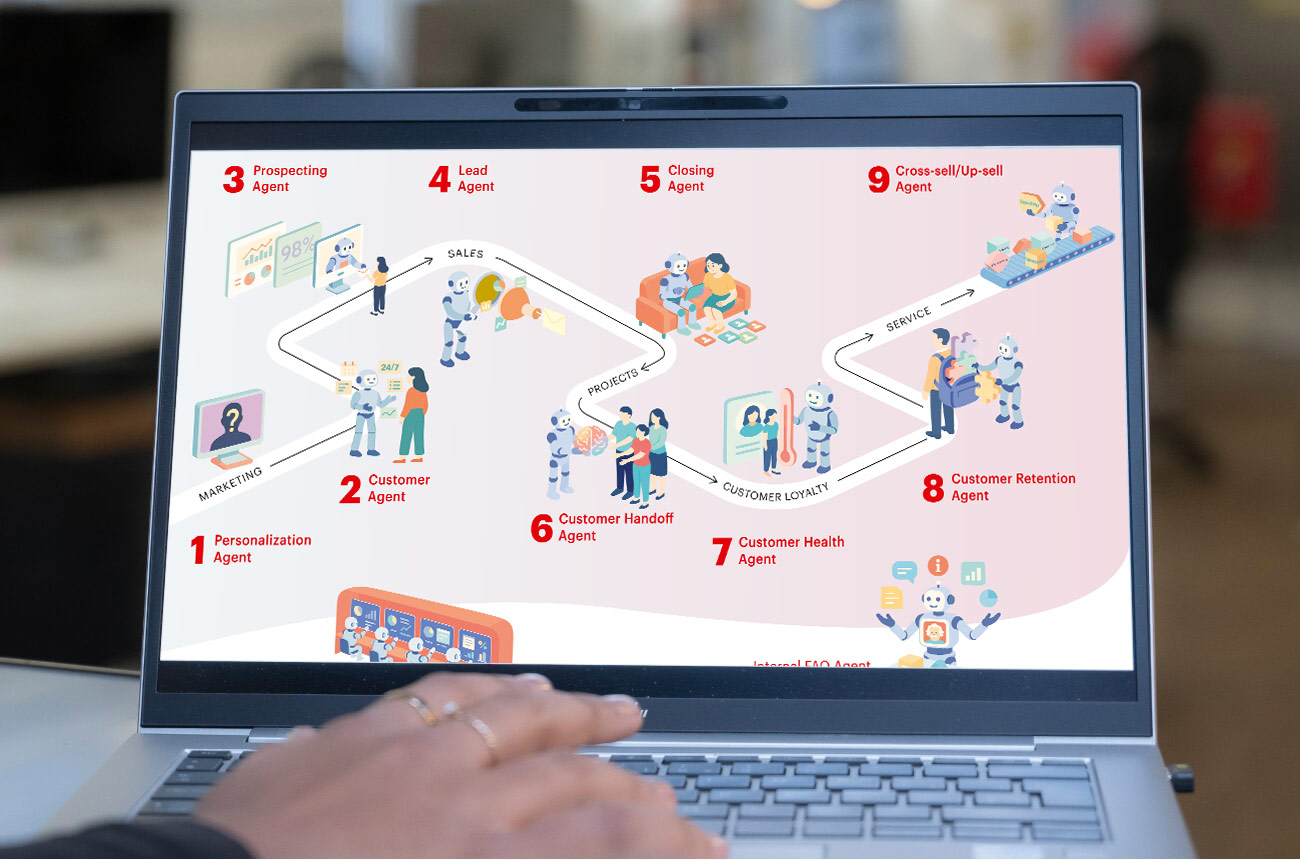
HubSpot bundles its AI features under the name Breeze. For Sales, the most interesting category is the Breeze Agents – AI “teammates” that take over entire workflows. The most relevant one for mid-sized Sales organizations – and the natural starting point – is the Prospecting Agent.

Prospecting Agent – the Digital BDR
A quick definition: BDR stands for Business Development Representative – the role in Sales that works before the actual Account Executive: researching target customers, qualifying them, making initial contact, and setting appointments. In traditional mid-sized company structures, this is often not a separate job but a task that field sales representatives handle “on the side” – and precisely for that reason, it regularly falls short.
This is the agent with which most companies can sensibly start – and the leverage is significant. It addresses exactly the activities outlined in the disconnected-systems section – research, preparation, and initial outreach. Specifically, it takes over:
-
Researching target customers based on your defined ideal customer profile (ICP). The AI searches websites, news, job postings, funding announcements, LinkedIn activity, and CRM history – and creates the results as easy-to-understand account briefings.
-
Identifying buying signals among existing customers: Who has visited the pricing page three times? Which customer has advertised a position that perfectly matches your offering? Which lead has been inactive for six months and is now active again? These signals are almost always lost in day-to-day business today.
-
Identifying the right contacts within the account – including role, responsibilities, and, where available, verified contact details.
-
Preparing personalized initial outreach in German, French, and English – using the tone of voice you approve, with references to specific triggers such as news, personnel changes, or product launches. The salesperson reviews, adjusts, and approves the message.
-
Sending at the right time and handing the conversation over to a human as soon as the lead responds. The salesperson therefore enters an already warm, qualified conversation.
Since April 2026, HubSpot has charged for the Prospecting Agent on an outcome-based model – around USD 1 per recommended lead, with a 28-day free trial (source: HubSpot Spotlight, hubspot.com/spotlight). This makes it possible to calculate the business case properly before committing any budget.
Three points to take away:
The Sales revolution that takes place internally as a result is unavoidable. But it is also manageable: Companies that manage it properly will have a Sales organization within 6–12 months that sells more, spends less time on administration, and is easier to manage than ever before.
As a Swiss agency for AI-driven Marketing, Sales, and Service solutions, we support companies throughout this journey: from CRM setup and Sales process harmonization to the concrete implementation of AI agents such as the Prospecting Agent in HubSpot. Pragmatic, compliant with Swiss and EU data protection law, and always with the goal of generating more revenue with less friction.

Sales Reality Check
(90 minutes, free of charge)
Together with you and your Sales management, we examine where data is currently being lost in your Sales process, which disconnected systems are costing you efficiency, and where the greatest AI leverage lies. You receive an assessment with three prioritized recommendations for action – with no obligation.

Prospecting Pilot
(4 weeks)
For companies that already use a CRM: We set up the Prospecting Agent specifically for a defined account segment, measure the impact, and provide a reliable business case after four weeks – with no lock-in.
Andrea Roch is CEO at business4you, a Swiss agency for AI-driven Marketing, Sales, and Service solutions based in Biel. She supports mid-sized companies in implementing HubSpot, digitalizing Sales processes, and using AI agents in Marketing, Sales, and Service.
Over the past 24 months alone, the business4you team has implemented 15 CRM projects of various sizes and supported more than 8 companies with the AI-supported digitalization of their Sales operations. Areas of focus include HubSpot implementation, Sales and Marketing automation, Breeze AI Agents, and data protection-compliant AI strategies for Swiss mid-sized companies.