- Best of Breed is today's standard: almost every company works this way – the only question is whether with a plan or without.
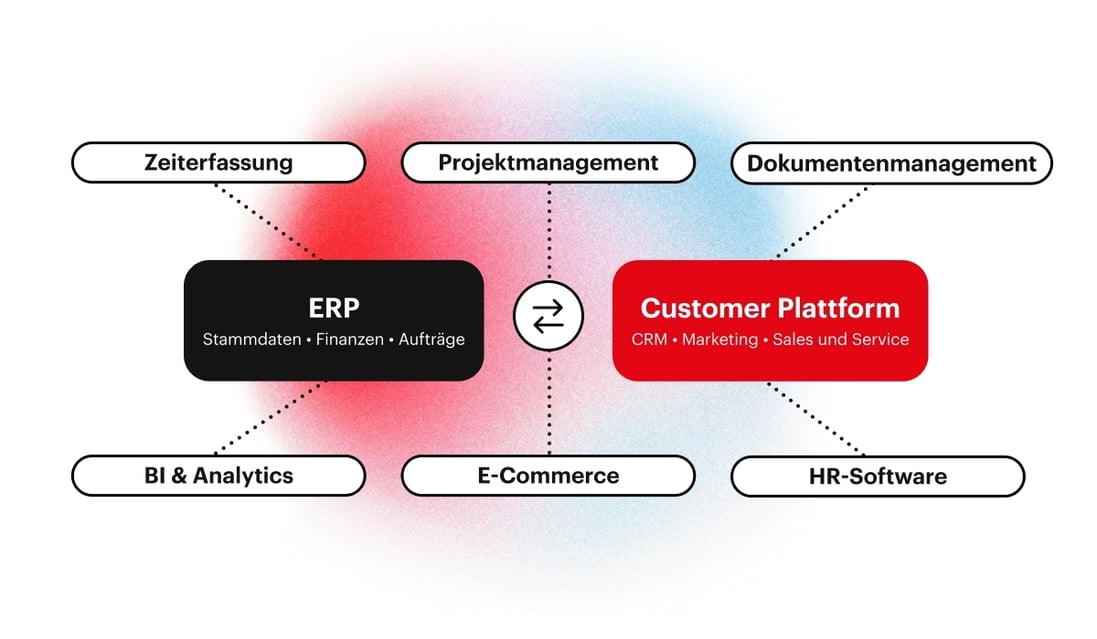
- The non-negotiable core: an ERP (Abacus, Bexio, Klara, SAP Business One) plus a customer platform (in Switzerland, usually HubSpot).
- Third-party systems complement situationally: time tracking, project management, document management, expenses, e-commerce, BI, HR and industry-specific tools.
- An MVP setup between ERP and HubSpot is typically live within 4 to 8 months.
- Success is not decided by the choice of tools, but by architecture and interface discipline.
- AI as a growth lever only works on a clean data foundation – otherwise AI scales the chaos instead of the value creation.
When we ask in initial conversations what a company's tool landscape looks like, we typically hear: "We have our ERP, our CRM, an external tool for email marketing, the project managers work with ClickUp, time tracking runs via Timetool and the website via WordPress." – That is Best of Breed. Full stop.
The question is never whether you work best of breed. You do. The only question is: did your stack grow intentionally or by chance? Did someone take responsibility for the architecture, or did it evolve over the years because each department chose whichever tool seemed convenient at the time?
That is exactly where the success or failure of digitalization – and the use of AI – is decided. Not in the choice of tools. In the architecture.

What is Best of Breed?
Best of Breed is an architecture principle in which the strongest tool is chosen for each core business area – rather than a single platform that is supposed to cover everything. These specialized tools are connected via open interfaces so that data flows cleanly and processes remain consistent end to end.
Definition Best of Breed: An architecture principle in which the strongest specialized tool is used for each core business area and connected via open interfaces. The counterpart is the monolith approach, in which a single vendor covers as many functions as possible.
Best of Breed stands in contrast to the monolith approach, in which a single vendor covers as much as possible – with the promise of uniform licensing and consistent data management. Microsoft embodies this approach most consistently today, with Dynamics 365 plus Power Platform plus M365. In practice, however, the exact weaknesses typical of monolithic approaches emerge: high configuration and customization effort, long implementation cycles, opaque licence costs and – from our consulting experience, the most frequent killer – weak end-user adoption. Studies have shown consistently for years that more than half of all CRM projects fail primarily due to lack of adoption, not technology. Employees prefer to work with the tool that does their job perfectly, rather than a module that "can also do everything."
In recent years, Best of Breed has therefore clearly established itself as the dominant model. Specialist tools have improved in every area. SaaS vendors focus on one task and perfect it over years. A generic platform cannot keep up with that. Adoption beats breadth of features. Whoever ignores this builds stacks that nobody uses.
Every Swiss company with business activity needs two platforms as the non-negotiable core: an ERP for the financial-operational truth and a customer platform for the customer-facing truth.
The ERP manages master data, orders, inventory, invoices, financial accounting, payroll and VAT – in other words, everything that ultimately goes to the tax authority and the warehouse. In Switzerland, Abacus, Bexio, Klara, SAP Business One, Infor, Sage and industry-specific solutions dominate. Anyone with an existing, working ERP generally keeps it. ERP replacements are large, high-risk projects and are only undertaken when there is a clear reason.
The customer platform manages leads, contacts, companies, communication history, deals, service tickets and marketing activities. Here, HubSpot has established itself as the de facto standard for Swiss SMEs and mid-market companies in recent years. Smart CRM, Marketing Hub, Sales Hub, Service Hub and Content Hub map the entire lead-to-loyalty process end to end: from the first marketing contact through the sales pipeline and contract close (lead to cash) to service delivery, customer retention and cross-selling generation. Above all of this sits Breeze AI as the AI layer. Everything on a shared data model with a single customer view.
That is the non-negotiable core. These two platforms are as indispensable in a modern company as a bank account. The question is never whether you need them. The only question is which ERP and which customer platform – and how they work together.
How is HubSpot connected to an ERP such as Klara or Abacus?
Via HubSpot's open REST API and the standard interfaces of the ERP vendors. The ERP delivers customer master data, order and invoice status to HubSpot. HubSpot returns the customer journey data and the lead pipeline. Whoever calls a customer sees the open invoice. Whoever writes an invoice sees the conversation history. A clean MVP setup of this HubSpot-ERP integration is typically live within 4 to 8 months.
AI makes clean data architecture a prerequisite for growth – not a nice-to-have. An AI model intended to identify cross-selling opportunities, take over lead scoring or automate service requests is always only as good as the data foundation it operates on. Distributed data silos deliver no reliable predictions. Inconsistent master data produce embarrassing personalized emails. Missing customer history generates generic service responses – and sales teams lose confidence in the AI after the first poor suggestions.
The pointed truth: AI multiplies the architecture it finds. On a clean data foundation it multiplies value creation – through automated workflows, intelligent predictions and personalized customer interactions. In data chaos it multiplies the chaos – only faster, more expensively and with a more professional appearance.
Three questions are decisive before you invest in AI tools:
-
Is your customer data stored centrally?
-
Can you access every customer interaction across the entire customer journey?
-
Is your CRM the source of truth – or the backup for the Excel graveyard?
Only once these architecture questions are answered does AI become a strategic growth lever. This is exactly where the underestimated strength of a modern customer platform like HubSpot lies: Smart CRM, Marketing Hub, Sales Hub and Service Hub share a common data model – and Breeze AI operates directly on it. What would be a massive data engineering project in fragmented stacks is standard functionality here.
Best of Breed succeeds when four disciplines are consistently applied: a clear customer data hub, the ERP as master data truth, few but well-chosen interfaces, and a clearly defined architecture owner.
Best of Breed does not succeed on its own. When each department chooses its own tool and no one takes responsibility for the overall picture, tool sprawl results. In successful setups, we see four disciplines applied consistently instead:
First: A clear customer data hub. All tools that produce customer-relevant data write to the shared CRM. That is the only way to show a customer advisor at the press of a button what a customer has bought, asked, complained about and ordered. In modern stacks, that hub is HubSpot.
Second: The ERP as master data truth. Who is a customer, what does the product cost, what was invoiced – these questions are answered in the ERP, nowhere else. All other systems consume that data but do not write master data themselves.
Third: Few but well-chosen interfaces. Every additional interface is maintenance effort. Successful stacks have five to fifteen integrated tools with clear data flows, not thirty with unclear responsibilities. Anyone adding a new interface should be able to give a reason that goes beyond "would be nice."
Fourth: One person or team that owns the architecture. Someone needs to decide which data belongs in which system, which tool is used for which purpose, and which new tools may be added and why. Without this responsibility the stack becomes chaotic. In larger companies, this is a solution or data architect; in SMEs it is often the CIO role or an external architecture partner.
Best of Breed typically fails through four recurring patterns: Excel as the silent CRM, the assumption that the ERP can also do CRM, uncoordinated department tool purchases, and neglected interfaces.
These patterns often follow a kind of maturity-stage logic – from the early "Excel is enough for us" through "but the ERP can do CRM too" to advanced tool fragmentation.
Anti-Pattern 1: Excel is the silent CRM. The company has never introduced a proper CRM. The customer base sits in an Excel file, the sales pipeline is a table per sales employee, quotes are written in Word and sent by email, notes from customer conversations end up in Outlook folders, and KPI reports are assembled by hand by the assistant. It works somehow – for years. And that is exactly the trap. Anyone asking "what did this customer order in 2023, and who last spoke to them?" needs ten minutes, three people and two Excel files for a half-correct answer. The data is there but not accessible. The knowledge is in the company but not retrievable. Anyone trying to grow on this basis enlarges the problem with every new customer.
Anti-Pattern 2: "But the ERP can do CRM too." Abacus, Bexio, SAP Business One – most ERPs today have contacts, sales opportunities and simple activities integrated. The obvious thought: "We already have a contacts module, sales can work there, then everything is in one place." In reality this almost never works. ERP systems are built for accounting and order processing, not for the sales day-to-day. Pipeline views, lead nurturing, marketing automation and customer journey reporting are missing – and the interface is trimmed for accuracy, not for speed. The result: sales works in Excel anyway, because the ERP module is too cumbersome. The supposed "everything in one place" becomes an unused module for which licences are paid year after year. Sales teams need sales tools, not accounting software with a contact tab.
Anti-Pattern 3: Each department buys its own tool. Marketing takes Mailchimp, sales uses Pipedrive, support has Freshdesk, management sees their KPIs in Excel, accounting lives in Bexio, and HR manages employees in parallel in Klara. No two tools speak to each other. Result: three different versions of the customer list, nobody knows any more who is a customer and what the customer wants. That is not Best of Breed. That is tool anarchy.
Anti-Pattern 4: "We will do the interface later." Tools are introduced without planning the integration into the overall system. Three months later someone discovers that data is being transferred manually, and six months after that the practice has become entrenched. Interfaces belong in the decision, not in the maintenance backlog.
If your stack today shows signs of these anti-patterns, that deserves an honest answer. Best of Breed only works with architectural discipline. Without it, you get the worst properties of both worlds: tool variety without consistent data.
We have been building our own in-house team of data and IT architecture specialists at business4you for some time. Architecture is not something you do on the side or delegate to external generalists. It is the foundation on which everything else stands – lead-to-loyalty processes, data quality, reporting, growth.
We know HubSpot in depth – and we build reliable interfaces between HubSpot and every ERP or third-party system that provides an open REST API. Our core competence lies exactly there: at the connection between systems, where it is decided whether a best-of-breed stack functions as an architecture or ends as a data patchwork. We build architectures that hold up in five years, not just survive the next campaign.
Our job does not start with a HubSpot setup. It starts with an honest look at your stack:
-
Which tools are running today? Which do you really need, which are ballast?
-
Where do data breaks occur that cost you money and time operationally?
-
Which interfaces are missing, which are broken, which are unnecessary?
-
What does your customer journey from lead to loyalty look like today, and where are you losing customers along the way?
From this analysis comes a stack picture with clear recommendations: what stays, what goes, what is added. And only once the architecture is right do we talk about HubSpot configuration, integration and implementation.
What sets us apart: strategy, architecture consulting, implementation and development – entirely in-house. No handovers to external partners, no responsibility gaps between consulting and execution. One client, one team, one result.
Reduce complexity and increase impact. That only works when the architecture is right. Best of Breed with a plan.
Andrea Roch is CEO at business4you, a Swiss agency for AI-driven marketing, sales and service solutions based in Biel. She guides mid-market companies through the implementation of HubSpot, the digitalization of sales processes and the use of AI agents in marketing, sales and services.
In the past 24 months alone, the business4you team has delivered 15 CRM projects of varying sizes and supported more than 8 companies in the AI-assisted digitalization of their sales operations. Focus areas: HubSpot implementation, sales and marketing automation, Breeze AI Agents, privacy-compliant AI strategies for the Swiss mid-market.