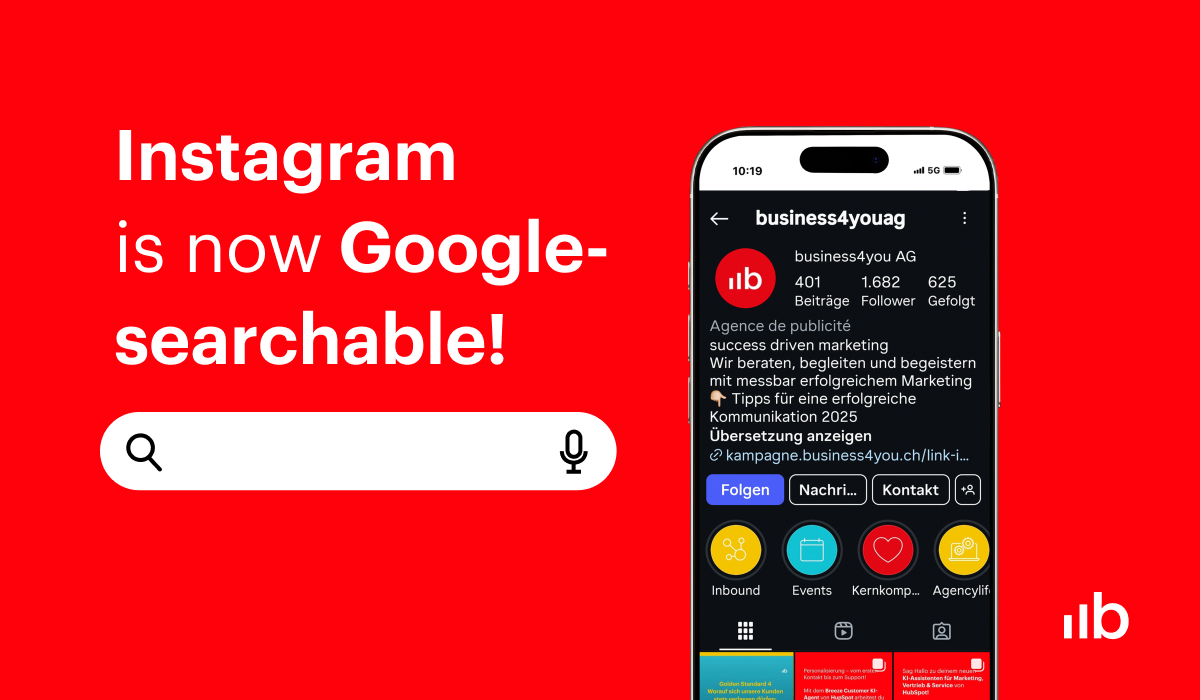
An important change is emerging in digital marketing: Google has recently started displaying public Instagram content from company and creator accounts directly in search results. This means that what previously almost exclusively generated reach within the Instagram app is now increasingly visible outside of it.
This offers companies a number of opportunities - but also new challenges and strategic decisions. The development is still ongoing and is expected to be rolled out gradually. The conditions could therefore still change. But those who act now are likely to secure a decisive advantage.
What exactly has changed?
For a long time, Instagram was a "closed world" whose content was primarily searchable and visible to registered users. Now, public posts - i.e. reels, carousels, images, captions and even comments - can appear directly in Google search results.
In concrete terms, this means that your Instagram posts become "micro landing pages" for search engines:
- Captions can be treated like classic SEO page titles.
- Alt texts for images become an important ranking factor.
- Hashtags help Google to understand the thematic context of your content even better.
Companies and content teams that have always paid attention to SEO best practices in their social media activities (well done!) now have a clear advantage.
The big opportunities for your company
- More reach: You can now also reach people who google your topics but don't actively use Instagram. This significantly increases your potential target group.
- More visibility in the SERPs: Visually appealing Instagram content can stand out in the search results (SERPs) and displace classic text results from competitors.
- Longer lifespan of your posts: Instead of only being visible for hours or days, your posts can now generate traffic as relevant search results for months or even years.
- New traffic sources: Users can go directly from Google to your Instagram profile and from there, ideally, to your website - perfect for leads and sales.
- Strengthen expert status: If your post appears as the top answer to a search query, this increases your credibility and trust in your brand.
The new challenges and risks
- Loss of control over context: Your post may appear in search results alongside competitor content, critical commentary or even in controversial political debates. You lose control over the original narrative.
- Increased strategic effort: Every post must now also be optimized for search engines. This requires a well thought-out keyword strategy for captions and alt texts.
- Reputation risk due to old content: Old, unprofessional posts or posts that no longer match the brand image (the classic "pool photos" from the team event or long outdated offers) can suddenly become prominently visible and damage your brand.
- Stronger competition: Millions of new visual contents are now competing for the best places on Google. The competition for attention is growing.
- The "zero-click" danger: There is the possibility of zero-click search, in which the answers to search queries are delivered directly by AI support - and there is no longer any reason for the person asking the question to make another click.
- Data protection issues: The broad indexing of social media content on external platforms could give rise to new data protection discussions.
Strategic outlook: What's behind this?
This opening is no coincidence. After Meta recently announced that it would use public user contributions to train its AI, this step could be a strategic "appeasement": You take and use data, but in return you give more reach to the outside world. Whether this remains just a storm in a teacup or reshuffles the cards in digital marketing remains to be seen. One thing is certain: The importance of social content for SEO will continue to increase massively.
How to benefit optimally - our recommendations for action
- Carry out a content audit as quickly as possible:Check your entire Instagram profile. Archive or delete posts that contain internal information, are no longer up to date or present an unprofessional image. Clean up before Google indexes your content.
- Develop an Instagram SEO strategy:
- Optimize Captions:Write captions like blog titles. Integrate relevant keywords that your target group would search for on Google.
- Use alt texts consistently:Assign a short, precise and meaningful alt text for each image. Describe what can be seen and integrate keywords.
- Use hashtags strategically:Use hashtags not only for the Instagram community, but also for clear thematic categorization for search engines.
- Understand your profile as a landing page:Your bio must be clear, convincing and up-to-date. The link in the bio becomes even more important as a central point of contact for Google.
- Quality over quantity:Invest time in high-quality, relevant and SEO-optimized content instead of quick mass posts. An evergreen post that ranks on Google is worth more than ten short-lived stories.
- Only use opt-out with caution:You can deactivate indexing in the settings. However, we do not recommend this in most cases, as you are missing out on an enormous opportunity for reach.
Conclusion: Act now and secure the advantage
Opening Instagram to search engines is a milestone for your marketing. Swiss SMEs that adapt quickly and strategically optimize their content will gain a clear competitive advantage. With the right know-how, you can secure pole position in a changing digital world.
Use this opportunity to make your brand more visible, more relevant and more successful. We are happy to answer any questions you may have!